Posts

Where Do You Use Stranded Copper Wires?

 Indian Bare Copper Winding Wire are by far the most popular metal material. No other metal possesses such a diverse set of qualities that make it an ideal material for the production of electrical cables. Copper's modest conductivity makes it ideal for low-voltage electrical transmissions. Many wires are bundled or stranded together to increase strength or flexibility. Stranded Copper is most popular for wires. No other metal has as many properties that make it perfect for electrical cable manufacture.  Copper's low conductivity is suited for low-voltage transmissions. Copper's tensile strength, electrical conductivity, corrosion and creep resistance, durability, longevity, ease of installation and soldering, and thermal conductivity make it a good metal for electrical wiring.  Copper occurs naturally. Because of its flexibility, stranded copper wire is suitable for moving and vibrating machinery. Strung copper wire comes in various shapes, which is the subject of this a...
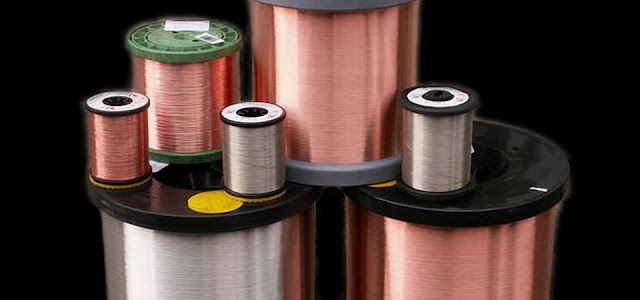
Why is Copper a Preferred Choice for Electric Connectors?

Copper metal is used for a range of applications due to its unrivalled physical and chemical properties. Whether it is electric wires, TV, computers, electrical appliances and other electric gadgets copper is a preferred metal for all these electric applications. It is extensively used in power-driven gadgets, cables, busbars, electrodes, heat exchangers and electrical connectors. Connectors are an integral part of the whole electric system in the house or in a factory. These devices are used in circuits to perform connection and disconnection operations. Connectors can be connected and disconnected by using simple tools or by hands only. Properties of copper metal that make it excellent manufacturing material for electric wires and connectors:  1.    Low Resistivity Copper connectors are generally used for power generation, transmission, and distribution. For the generation and transmission of electric current through metal, the electric resistivity should be minimum. Th...

Braided or Stranded Copper Wire- which one to use for better/ safe connectivity?

 In electrical applications like cable assemblies or harnessing of the wires, choosing between the stranded wire vs braided wire would always depend on the task.  When you choose the right type of wire, it would not only ensure the safety of the application but safeguard the surrounding from any mishappenings. Indeed there are differences between both types of wires (braided and stranded) that stop one for a moment to think wisely.  So let's find out what these types of copper wire are and which one must be used for a better connectivity option. What is a Braided Copper Wire?  Among electrical engineers, Flexible Electrical Copper Braided Jumpers are very popular. They can be used to change any circuit or diagnose connection issues.  The shielding of braided copper wires is made up of numerous tiny wires that are tightly woven to form a meshed tubular shape that further wraps around a conductor. It allows flattening the wire tubing so that a specified width can ...

Determining Types of Copper Wire

The Basic use of wire is to transmit electricity or telecommunications signals or to bear mechanical loads. Since its invention, it has been considered the golden standard for electrical wiring.  Copper wires are the best kind of electrical conductor and they have different uses. The invention of the telephone especially raised the further demand for it. It is being used in various types of electrical equipment. Let’s find out a few general purposes wire styles. Types of Copper Wire Uses GPT Wire Circuit Wiring TWP Wire Usable as a thinner wire HDT Wire Used in Vehicles for the protection SXL Wire High-temperature applications GXL wire Used in engine compartments for higher heat resistance TXL Wire Applicable as lightweight wire Nowadays Copper wire is typically us...

Advantages of Flat Enameled Aluminum Wire

 What is enamel coating on a wire? These refer to the varnishes that are coated on the surface of metal wires, mainly aluminum or copper. The main function of this coating is to form an electrical insulation film possessing thermal resistance and chemical resistance properties. These enamel coatings are mainly used for the manufacturing of magnet wires. Advantages of a Flat-Enameled Aluminum Wire 1. Conductivity: They possess amazing Conductivity properties. Due to their conductivity, they are able to produce a large amount of electricity. The transformers which are built up by flat enameled aluminum wires will lose less energy than compared other metallic wires.  2. Size: One of the most popular reasons why enamel wires are widely used as applicators is thin enameling insulation. Due to the thin size of the wires, they take up very little space in the coil which makes it more efficient as a whole and makes it easier to use. Because of that, the coil can generate a lot of ener...

Uses of Copper Wire

Image
Copper has been the most favored metal for electrical wiring and connectors for centuries since the invention of the telegraph and electromagnet. Its growth accelerated with the introduction of the telephone in 1876. For nearly 200 years, copper has been extensively used in various electrical settings, telecommunications, power generation, transmission, and distribution. Reddish-brown in color, copper is a highly ductile and malleable metal. It can be stretched and drawn into wire strands as thin as human hair. The metal has a high thermal and conductivity and can be put to many uses. Among all the uses of this versatile metal, 60% of copper is used in making electrical wires. Copper wire: what makes it popular in electrical wiring? All metals have some amount of resistivity against electric currents and hence they need a power source to push the current through them. The lower the resistivity and better is the conductivity. Copper has a low-level of resistivity, makin...